Pre-Industrial History
Pre-Industrial History of the St. Louis River
Fond du Lac Region: “Head of the Lakes”
Native Americans have lived in Northeastern Minnesota for thousands of years. The ancestors of the present-day Chippewa—also known as the Ojibwe and self-referred to as the Anishinaabeg—have resided in the Great Lakes region since at least 800 AD. For a time, the Lakota and the Chippewa coexisted in the area and also fought for territorial control. Oral traditions speak of a westward migration from the Atlantic Seaboard through the Great Lakes to present-day Lake Superior.
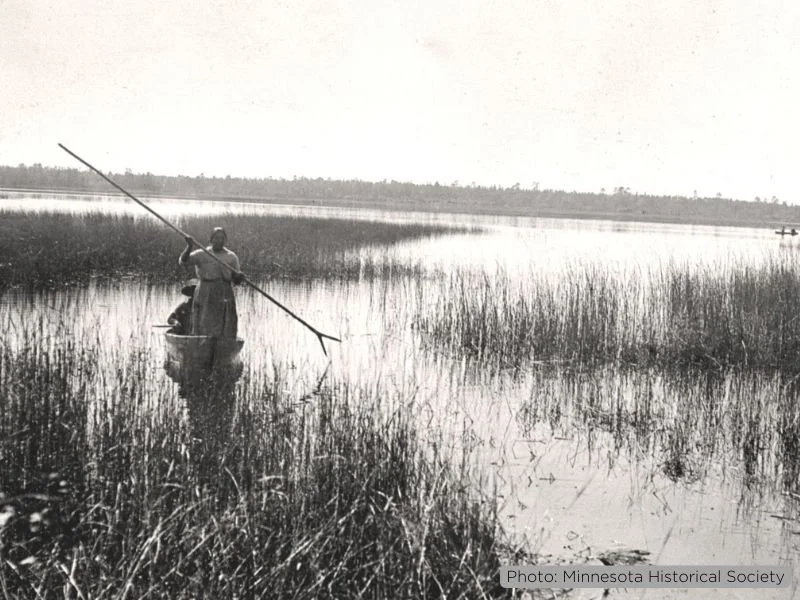
Photo: Native Americans harvesting manoomin (wild rice). Credit: Minnesota Historical Society
Europeans arrived in the region in the 1600s to explore, trade, and introduce Christianity. Today, the Fond du Lac neighborhood lies approximately 20 miles upstream from Lake Superior, but during early exploration the entire area was commonly referred to as Fond du Lac, or “Head of the Lakes.”
Native American Life at Fond du Lac
Prior to the early 1800s, the Fond du Lac Band consisted of villages scattered along the St. Louis River at what are now Fond du Lac, Superior, Minnesota Point, Wisconsin Point, and Cloquet. Seasonal camps were also established at Spirit Lake and Indian Point. Communities relied on wild rice, game, fish, and other native plants. As fur traders moved into the region, many tribal members settled more permanently, trading furs for food and European goods.
Exploration
The St. Louis River was a major travel corridor for Native Americans, fur traders, missionaries, and other intrepid explorers. During the era of canoe travel, it served as a key route between Lake Superior and the Upper Mississippi region, as well as northward to Lake Vermilion. Travelers ascended the river to Grand Portage, about a mile and a half above Fond du Lac, where they carried canoes and cargo seven miles to bypass rapids and falls. The portage ended near Maple Island, below present-day Scanlon. From there, travelers continued by water to Knife Falls, where the mile-long Knife Portage was required. One of the first European explorers to reach the area was Daniel Greysolon, Sieur du Lhut, in the summer of 1679. The city of Duluth now bears his name.
Fur Trading
French and British fur traders entered the Fond du Lac region as early as the 1750s. Among the most notable were Jean Baptiste Cadotte and Jean Baptiste Perrault, who built Fort St. Louis in 1793 near present-day Superior. The fort was enclosed by a stout palisade of 20-foot posts and featured heavy double gates. Inside were dwellings, workshops, and storage buildings surrounding an open courtyard where Native Americans brought furs and game. Fort St. Louis closed in 1816, after which the American Fur Company established a new trading post in Fond du Lac. This post included large gardens and nearby Native American lodges and gardens located on an island in the river.
As the fur trade declined, companies diversified. In 1834, the American Fur Company established commercial fisheries to harvest Lake Superior trout and whitefish, operating a packing station at the Fond du Lac post until the late 1840s.
The First Missionary
American Fur Company president Ramsay Crooks encouraged missionary activity at trading posts. Missionaries established schools for Native American children, staffed by ordained ministers and lay teachers. The first mission in Fond du Lac was built by Reverend Edmund Franklin Ely. In 1834, the area’s first Christian marriage was performed there.
Development
Construction of the Soo Canal in 1852 renewed interest in the Twin Ports as a shipping hub. In 1854, the U.S. government signed the La Pointe Treaty with the Chippewa Tribe, opening the St. Louis River region to settlement. Towns were platted on both sides of the river in 1856, and the City of Superior soon grew to more than 500 residents.
That same year, the region’s first road—known as the Military Road—was built to connect the Head of the Lakes with Fort Snelling on the Mississippi River. Originating in Superior, the road stretched 50–60 miles to the junction of the St. Croix and Mississippi Rivers and remained the only road into the area for more than a decade.