Evaluating the Impacts of Restoration for Local Communities
Authors: Shannon Rutherford O'Neill & Molly Wick
Introduction
Our everyday lives are less directly connected to our immediate ecosystems than they were in centuries before. But we still depend heavily on clean and healthy local ecosystems for drinking water, clean air, and also for opportunities to learn, grow, and have fun with our favorite people. As such, ecosystem restoration work can benefit more than just the flora and fauna—it can also have huge benefits for communities.
Natural resource managers have historically tracked the success of ecosystem restoration work based on its impact on the ecosystem itself. This has included monitoring the presence of contamination in soil, the quality of the water, or how fish and wildlife populations respond to improvements in habitat. However, it is harder to evaluate the impact of ecosystem restoration on people. To try to do that, Wisconsin Department of Natural Resources (WDNR) partnered with students at the University of Minnesota Duluth to identify indicators of community impacts of restoration.
What did the class do?
Throughout the spring 2025 semester, the WDNR staff worked with Water Resource Sciences Department to help identify and refine community desires for the Allouez Bay Phase 2 restoration project. Students enrolled in Dr. Afton Clarke-Sather’s water policy class spent the semester analyzing data collected from St. Louis River Alliance’s River Activities Questionnaire to determine what matters most to members of the community in regards to this restoration project, as well as identify potential barriers to the use of Allouez Bay. After analyzing the data, students developed recommendations for indicators which can be used to ensure the project meets community needs and expectations. An indicator is a signal that can be measured to show the condition or state of a more complex system. In addition, the analysis of questionnaire data also revealed ways to best balance the desires of community members and limit barriers to use of the restoration area.
What were the recommendations?
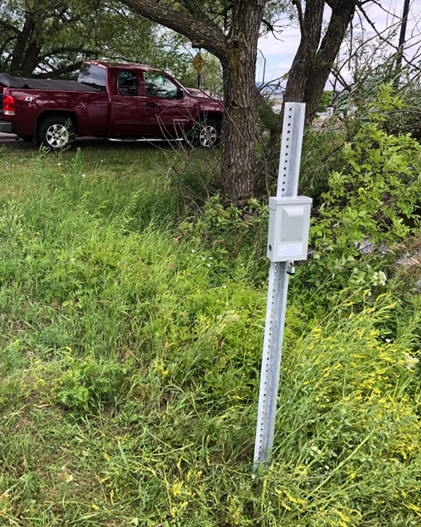
Photo: Trail counters have been used at other sites in the area, like this one at Pickle Pond in Superior, to evaluate changes in site use with restoration activities.
Several key topics were identified by students as the most prevalent concerns of community members. Recreational opportunities, including birding, fishing, paddling, swimming, boating, hiking, and wildlife viewing are a priority for visitors to Allouez Bay. The restoration project stands to improve opportunities for these activities for visitors. Wayfinding and safety concerns pose a significant barrier to entry for many users. Survey responses indicated that users feel uncertain about the safety of recreating within certain areas within Allouez Bay. The restoration project or aligned efforts could also help address these barriers through communications, small group interpretive gatherings and events such as those offered by the St. Louis River Alliance, and establishment of amenities or infrastructure.
To measure the success of these actions, the class recommended several indicators. Recreational use of the site is anticipated to increase with the restoration project. This can be measured by utilizing trail counters or cameras, as well as data from apps like eBird, iNaturalist, and FishBrain before and after the project is completed. Perceptions of safety and access can be measured using ongoing collection of questionnaire data. Questionnaire data can also be used to evaluate if visitors’ sense of connection to the place is deepening. Lastly, navigating website usage can be measured to evaluate if an increasing number of residents are utilizing wayfinding materials.
Next steps
WDNR will begin work on a design for Allouez Bay Phase 2 in the next year. In that process, WDNR will develop a monitoring plan that aims to incorporate these recommendations, pending feasibility. The project partner team will work together to identify which indicators could be incorporated based on available funding. Ultimately, the partner team is interested in being able to not only demonstrate project success, but also illustrate it’s beneficial impacts on local communities.